Chief Executive Officer and sole shareholder of Dzata Cement Limited, Ibrahim Mahama, has urged Ghanaians to develop greater confidence in their ability to establish and grow large-scale businesses, particularly in industries traditionally dominated by foreign companies.
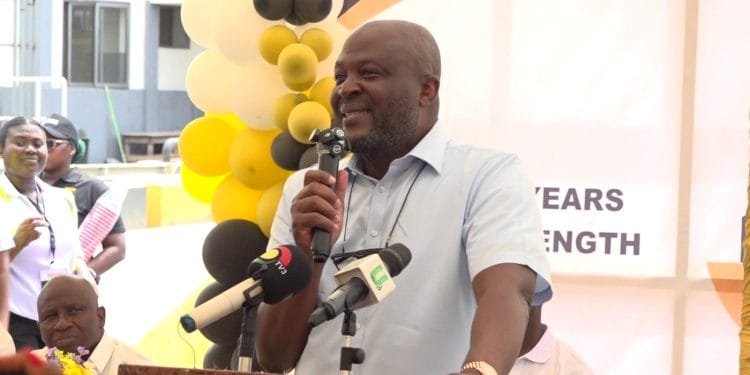
Mahama made the call during the fifth anniversary celebration of Dzata Cement on October 6, 2026, reflecting on the difficulties involved in establishing the cement business and using its journey to argue that Ghanaian entrepreneurs can take on major industrial projects.
Ibrahim Mahama’s case for Ghanaian businesses
Mahama said his decision to venture into cement manufacturing was partly driven by a desire to challenge the perception that Ghanaians could not build a cement plant.
“There are other ventures that I want to prove to Ghanaians that we can’t always be beggars and we can’t only just be employees to foreign companies. We can build it ourselves,” he said.
He said the idea developed from his earlier experience as a cement transporter and mining contractor.
After following his trucks to Ghacem’s facility in Takoradi and observing the production process, Mahama said he concluded that establishing a cement plant was achievable.
He subsequently travelled to Germany, engaged equipment manufacturers and secured bank financing for the project. He said the development later encountered serious financial and operational difficulties, requiring support from his younger brother and other individuals before the installation of the plant’s equipment could be completed.
From an idea to a Ghanaian-owned cement company
Mahama also highlighted the role of distributors who supported Dzata Cement during its early stages.
He recalled that the company faced difficulties raising enough funds to clear imported cement, but distributors rallied around the business and helped it get its products into the market.
He also publicly acknowledged former Trade Minister Alan Kwadwo Kyerematen for supporting the project during the administration of former President Nana Addo Dankwa Akufo-Addo.
“Alan, wherever you are, I’m giving you a thumbs up. Thank you very much for standing behind us,” Mahama said.
Kyerematen had previously visited the Dzata Cement plant in 2021 and described the investment as a significant Ghanaian contribution to the cement industry. A Ghana News Agency report from that period said the plant was a wholly Ghanaian investment and had German technology, with an investment value reported at more than US$100 million.
Mahama also recalled an earlier conversation with a former Ghacem executive identified as Morton, whom he said doubted that a Ghanaian could establish a cement manufacturing plant.
He said the comment strengthened his determination to prove otherwise.
Succession is part of the business model
Mahama’s reflections were not limited to how Dzata Cement was established. He also spoke about how established Ghanaian businesses can prepare younger people to take over management responsibilities.
He said he deliberately stepped away from the company’s day-to-day management to give younger leaders room to take risks and develop their managerial skills.
“In life, some of us should learn these lessons. We won’t live forever. So sometimes we should give the children the opportunity to be able to take that risk of managing,” he said.
He described his approach as a gradual succession process in which younger members of the next generation are introduced to the business, trained and eventually given greater responsibility.
For Mahama, the principle goes beyond Dzata Cement. He argued that businesses need to be built with continuity in mind rather than remaining dependent indefinitely on their founders.
Why his message matters
Mahama’s comments come amid continuing discussions about Ghana’s industrialisation and the need for stronger locally owned businesses.
His own example illustrates some of the challenges involved in moving from entrepreneurship into capital-intensive manufacturing: access to finance, equipment acquisition, operational difficulties and the need for support from distributors and other business partners.
His argument, however, remains a personal and entrepreneurial position rather than evidence that Ghanaian businesses generally face no structural barriers to scaling.
The significance of Dzata Cement, in his telling, is that a Ghanaian-owned company entered a sector where major international and foreign-backed companies have historically had a strong presence. A 2021 GNA report similarly described the investment as a wholly Ghanaian venture and noted the plant’s use of German technology.
The broader challenge
Mahama’s call ultimately shifts the discussion from whether Ghanaians can establish businesses to whether more locally owned companies can successfully scale, survive leadership transitions and compete in capital-intensive sectors.
His five-year reflection on Dzata Cement places that question at the centre of the company’s anniversary: Ghanaian entrepreneurs, he argues, should not limit themselves to participating in businesses owned elsewhere but should also seek to build enterprises of their own.
That remains the central message from Mahama as Dzata Cement marks five years.