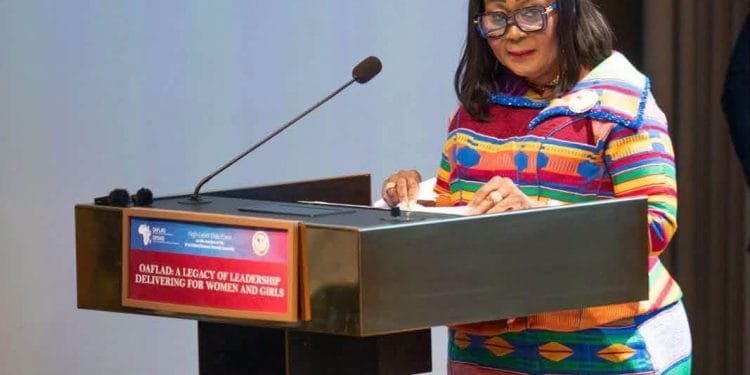
Ghana’s First Lady, Lordina Dramani Mahama, has called on African governments and development partners to increase investment in healthcare, education and women’s economic empowerment, arguing that progress in these areas is closely linked to the continent’s long-term prosperity.
Mrs Mahama made the call during the “Passing the Baton” session at a high-level Organisation of African First Ladies for Development (OAFLAD) side event in New York on the sidelines of the 81st United Nations General Assembly.
The meeting, held at the Ford Foundation Center for Social Justice, brought together African First Ladies and a First Gentleman under the theme, “A Legacy of Leadership: Delivering for Women and Girls.”
What Lordina Mahama said
Mrs Mahama argued that improving healthcare outcomes for women and children requires more than expanding medical services.
She called for healthcare systems that can reach mothers and children with a combination of maternal care, HIV prevention, early screening, nutrition support and other essential services.
“Health cannot be addressed in isolation. Education, women’s economic empowerment, and gender equity are essential to creating healthier families, stronger communities, and more prosperous nations,” she said.
Her argument was that health interventions need to be supported by social and economic opportunities that enable women and girls to remain in school, earn livelihoods and participate meaningfully in their communities.
She also called for access to quality healthcare, dignity and economic opportunities to be treated as essential needs for women and children across Africa.
Women’s empowerment linked to wider development
The First Lady placed particular emphasis on the economic position of women.
She said empowering women to establish sustainable livelihoods can have benefits that extend beyond individual households to communities and national economies.
“When a mother is healthy, when a young girl is shielded from harm and kept in school, and when a woman is empowered to build her own livelihood, the transformative ripple effects lift entire communities and drive national prosperity,” she said.
The message places women’s economic empowerment alongside healthcare and education rather than treating it as a separate development issue.
For policymakers, that approach means addressing barriers to health, education and economic participation together.
OAFLAD’s role
The discussions formed part of OAFLAD’s reflection on nearly 25 years of advocacy and development work.
The organisation was established during a period when HIV and AIDS posed a major public health challenge across Africa. Mrs Mahama said the collective leadership that characterised that period remains relevant as African countries confront continuing health and socio-economic challenges.
She urged members to use OAFLAD’s collective influence to strengthen partnerships with international organisations and other development partners.
The meeting also focused on the organisation’s direction for the next quarter-century.
Mrs Mahama reaffirmed Ghana’s commitment to integrating maternal healthcare, youth empowerment and gender equity into the country’s national development agenda.
Her comments also fit within a broader focus by her office on health access, education and women’s empowerment.
Earlier in 2026, the Information Services Department reported that the Lordina Foundation had identified health access, education and women’s empowerment as key areas of its work. The foundation has also reported interventions involving healthcare support, education assistance and economic empowerment programmes.
The First Lady’s latest remarks therefore extend an existing emphasis on these areas to a wider continental audience.
The focus on multiple areas reflects the interconnected nature of challenges affecting women and children.
Access to healthcare can affect family wellbeing, while education can influence opportunities available to girls and women. Economic empowerment, in turn, can provide women with greater capacity to support themselves and their families.
Mrs Mahama’s position is that these areas should be addressed together rather than through isolated interventions.The call also comes at a time when health financing and the sustainability of healthcare systems remain significant issues across Africa.