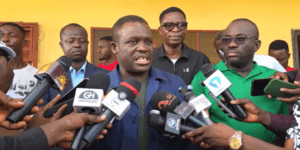

President John Dramani Mahama has renewed government support for the planned medical school at the University of Technology and Applied Sciences (UTAS), Navrongo, while attention is also being drawn to infrastructure challenges that have slowed the university’s expansion.
The development is significant for the Upper East Region, where the proposed medical school is expected to expand opportunities for health-professional training and strengthen the region’s healthcare workforce.
UTAS has been preparing for the establishment of a School of Medicine and Health Sciences. The university’s latest recruitment notice, published in July 2026, confirms that it is seeking lecturers and senior lecturers in disciplines including anatomy, physiology, biochemistry, pathology, microbiology, haematology and pharmacology to support the emerging medical school.
The push for a medical school in Navrongo is not new.
In 2025, the Ghana Health Service indicated that the Navrongo War Memorial Hospital would be upgraded into a teaching hospital to support medical training at UTAS.
The GHS Director-General, Professor Samuel Kaba Akoriyea, said the development would help create the conditions required for the university to train healthcare professionals in the region.
The proposal also follows an earlier commitment by President Mahama to upgrade the hospital as part of efforts to improve healthcare and support medical education in the Upper East Region.
UTAS itself said in April 2026 that it expected to establish a medical school and viewed the move as an opportunity to broaden its academic and research collaborations.
The medical school plans come against the backdrop of longstanding infrastructure constraints at the university.
A four-storey laboratory complex at UTAS was among three major GETFund projects reported to have stalled for years. The other projects were a four-storey student hostel and a lecture hall/office complex.
In May 2025, UTAS Vice-Chancellor Professor Albert Luguterah said the laboratory project had been awarded to Sunlu Ghana Limited in 2016 but had stalled amid issues surrounding the contract and its valuation. At the time, the reported revised contract value stood at about GH¢21.5 million.
The university has previously warned that inadequate laboratory facilities affect teaching and practical work.
In 2024, then Acting Vice-Chancellor Professor Samson Abah Abagale said the university sometimes had to collaborate with the Navrongo Health Research Centre for laboratory sessions and appealed for the completion of the laboratory complex.
The reported intervention involving President Mahama therefore comes at a critical point in UTAS’s development.
The university has expanded significantly since becoming an autonomous institution, but infrastructure has remained one of its major constraints. UTAS itself acknowledged in June 2026 that limited laboratory facilities and staffing remained among the challenges confronting the institution.
Government support for the medical school would also build on earlier financial assistance to UTAS. In 2025, the Education Minister announced that GH¢40 million in GETFund support would be shared equally among four public universities, including CKT-UTAS, for infrastructure expansion.
A medical school in Navrongo could have benefits beyond the university.
The Upper East Region has long relied on health facilities that serve both urban communities and surrounding rural populations. Establishing medical training capacity locally could create a stronger link between professional education, clinical practice and healthcare delivery in the region.
The proposed upgrade of the War Memorial Hospital is particularly important because a functioning teaching-hospital arrangement would be central to providing students with clinical training.
However, the medical school will ultimately require more than academic staff and a teaching hospital. Laboratories, lecture facilities, equipment and other supporting infrastructure will also have to be ready for the programme to operate effectively.
UTAS’s July 2026 recruitment exercise suggests that preparations for the medical school are continuing.
The university is now seeking specialist academic staff across several core medical disciplines, with applications closing on August 12, 2026.
The immediate test will be whether the government’s renewed backing translates into completed infrastructure and the institutional approvals needed for the medical school to begin operating.