
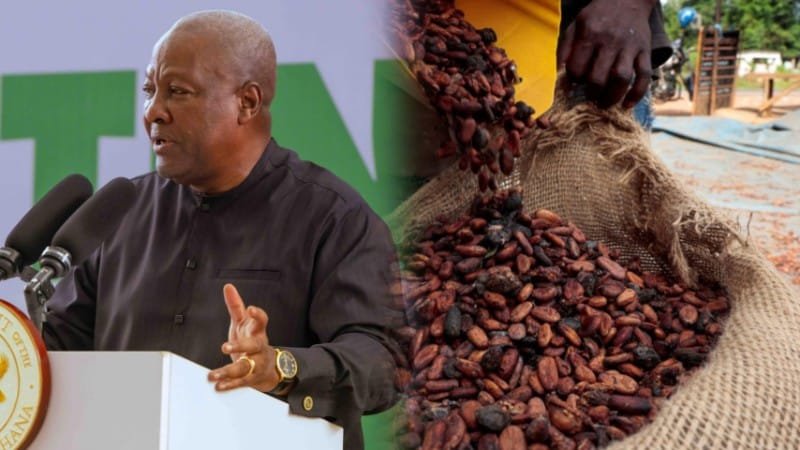
The Majority in Parliament has urged President John Dramani Mahama to assent to the Ghana Cocoa Board Bill, 2026, as the government pushes ahead with reforms aimed at restructuring the country’s cocoa industry.
The Bill was passed by Parliament on July 30 and is now awaitingpresidential assent before it can become law. The Majority’s latest call comes amid opposition from the New Patriotic Party (NPP), which has asked the President to return the legislation to Parliament for broader stakeholder consultation.
The disagreement centers on how Ghana should reform COCOBOD’s financing, cocoa pricing, farmer protection, governance and the wider cocoa value chain.
Majority backs presidential assent
The Majority has defended the legislation and called on President Mahama to disregard what it describes as opposition propaganda and give the Bill presidential assent.
The call follows criticism from the NPP, which has questioned aspects of the legislation and argued that further consultation is needed before it becomes law.
The NPP has specifically raised concerns about provisions in the Bill, including restrictions relating to cocoa farmland and the process through which the legislation was passed.
The disagreement means the next major step rests with the President, who must decide whether to assent to the legislation or return it through the constitutional process.
What the COCOBOD Bill seeks to change
The legislation is intended to replace the existing legal framework governing the Ghana Cocoa Board and provide a new statutory basis for the regulator’s operations.
Among its major provisions is a requirement that cocoa farmers receive not less than 70% of the Gross Free on Board (FOB) price realized by COCOBOD for cocoa. The provision is intended to give farmers a statutory minimum share of the value generated from cocoa sales.
The Bill also introduces a new financing model that would allow COCOBOD to source funding locally to finance cocoa purchases.
Deputy Finance Minister Thomas Nyarko Ampem previously explained that the new approach was designed to address challenges associated with the Board’s previous financing arrangements.
New financing model for cocoa purchases
Financing has become one of the major issues behind the government’s proposed restructuring of COCOBOD.
The Board’s traditional syndicated-loan model has faced difficulties amid Ghana’s debt restructuring and changes in access to international financing.
COCOBOD has subsequently been working on a new funding model for the 2026/27 cocoa season. The Board’s Chief Executive, Dr Ransford Abbey, said in July that the new model was expected to fund the coming crop season and expressed optimism about its ability to raise the resources required.
The Bill therefore seeks to provide a statutory framework for the new approach to cocoa financing.
Farmers to receive minimum 70% of Gross FOB price
One of the most significant provisions for farmers is the statutory price guarantee.
Under the Bill, farmers would receive at least 70% of the Gross FOB price realized by COCOBOD.
The legislation also provides a framework for determining producer prices and strengthens the legal basis for the Producer Price Review Committee and related technical structures.
The measure is intended to make the relationship between international cocoa prices and the prices received by farmers more predictable.
Wider reforms to the cocoa sector
The Bill goes beyond producer pricing and financing.
It would formally place COCOBOD under the supervision of the Ministry of Finance, giving legal backing to the government’s earlier decision to move oversight from the Ministry of Food and Agriculture.
The legislation also provides for measures covering:
- local processing and value addition;
- cocoa farm protection;
- regulation and quality control;
- licensing and enforcement;
- a Cocoa Farmers Pension Scheme;
- an Educational Trust Scheme;
- dispute resolution; and
- a Cocoa Board Tribunal.
These provisions are intended to create a broader legal framework for the regulation and development of Ghana’s cocoa industry.
NPP calls for broader consultation
The NPP has taken a different position on the legislation.
The party has urged President Mahama not to assent to the Bill immediately, arguing that it should instead be returned to Parliament to allow for broader consultation with stakeholders.
The party has also raised concerns about provisions relating to cocoa farmland. In particular, it has criticized Clause 81, arguing that restrictions under the provision could affect the property rights of farmers and landowners.
COCOBOD, however, has defended the legislation and rejected the criticisms levelled against it.
Cocoa farmers also seek review
The debate has extended beyond Parliament.
Some cocoa farmers have also called for the Bill to be reviewed before presidential assent, arguing that wider consultation is necessary.
Their concerns add another dimension to the disagreement over whether the legislation should take effect in its current form.
COCOBOD settles GH¢162 million obligation
Meanwhile, COCOBOD has taken steps to address some of its outstanding financial obligations.
On July 15, the Board announced that it had paid GH¢162 million in full settlement of outstanding obligations to individual Cocoa Bill holders who did not participate in the government’s Domestic Debt Exchange Program.
COCOBOD said the obligations had remained outstanding following the implementation of the debt exchange program in 2023 because of the Board’s financial constraints.
The payment forms part of efforts to address outstanding obligations as the institution transitions toward a new financing framework.
What happens next
The immediate issue is now whether President Mahama will assent to the Ghana Cocoa Board Bill, 2026, or send it back for further consideration.
The Majority wants the Bill to become law, while the NPP and some cocoa farmers are calling for additional consultation before presidential assent.
For cocoa farmers, the key issues will be how the proposed 70% Gross FOB guarantee, the new financing model and other reforms are implemented if the legislation receives presidential assent.
For the cocoa industry more broadly, the outcome could determine how Ghana finances cocoa purchases, regulates the sector and distributes value between farmers and other participants in the cocoa value chain.