
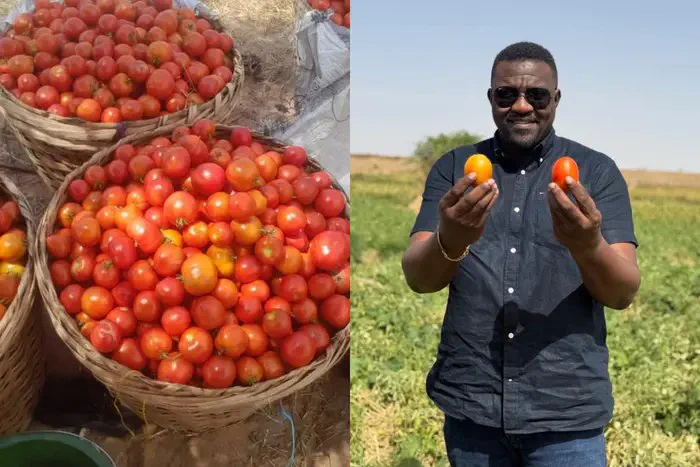
Tomato prices in Ghana could fall sharply in the coming weeks as local farmers begin bringing fresh produce to the market, Deputy Minister for Food and Agriculture John Dumelo has said.
Dumelo made the projection on Monday, September 7, 2026, as he outlined the government’s plans to increase domestic tomato production and reduce the supply gaps that have contributed to recent price pressures.
“The prices of tomatoes should see a sharp decline in the coming weeks as Ghanaian farmers have started harvesting,” Dumelo said in a social media post.
The expected price relief is tied mainly to supply. As more locally grown tomatoes enter markets, the government expects competition among sellers to increase and pressure on consumers to ease.
However, Dumelo did not give a specific price target or say how much prices would fall. The timing and size of any reduction will depend on the volume of tomatoes harvested and how quickly the produce reaches markets.
Beyond the immediate harvest, the government is preparing for a larger dry-season tomato farming programme expected to run from December 2026 to June 2027.
Dumelo said land preparation has already taken place in several parts of northern Ghana, with farmers expected to begin nursing and transplanting seedlings from October.
He also said solar-powered boreholes and irrigation inputs have been provided to support farmers during the dry season, when reliance on rainfall can limit production.
The move comes after Ghana faced renewed concerns over tomato supply earlier this year, including disruptions to imports from Burkina Faso. The two countries reached an agreement in July to resume tomato imports into Ghana, after restrictions had affected cross-border trade.
Ghana is also seeking to increase domestic production as part of a broader effort to reduce its dependence on imported tomatoes. In July, Agriculture Minister Eric Opoku said government interventions were expected to produce visible results within four months, including measures to expand irrigation and year-round cultivation.
There are already signs of a stronger focus on irrigated tomato farming. In the Upper East Region, the Irrigation Company of Upper Region Limited announced plans to dedicate 500 hectares under the Tono and Vea irrigation schemes to tomato production, with the aim of reducing reliance on imports.
For consumers, the immediate question is whether the current harvest will translate into noticeably lower prices in markets across the country. Dumelo’s forecast suggests that relief could come in the coming weeks, but actual prices will ultimately depend on supply, transportation, market conditions and demand.
The next major test will be the dry-season programme. If the planned cultivation from December through June delivers a steady supply, it could help reduce the seasonal shortages that often contribute to sharp movements in tomato prices.