
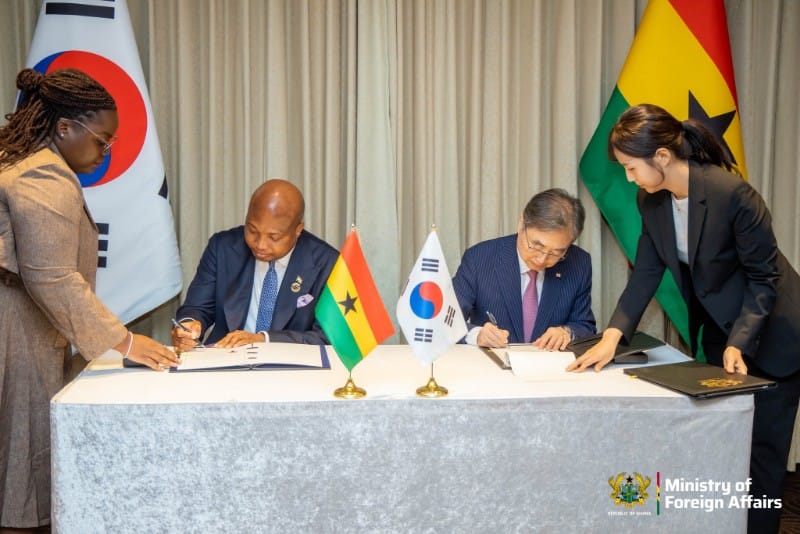
Ghana and South Korea have signed a new visa waiver agreement allowing holders of diplomatic and service passports to travel between the two countries without a visa. This marks the first such arrangement between the nations in nearly five decades of diplomatic relations.
The agreement was signed in Seoul on Monday, June 1, 2026, on the sidelines of the 2026 Korea–Africa Foreign Ministers’ Meeting. It aims to strengthen diplomatic cooperation, facilitate smoother official travel for government representatives, and enhance overall bilateral engagement between the two countries.
Ghana’s Minister for Foreign Affairs, Samuel Okudzeto Ablakwa, signed the deal alongside South Korea’s Foreign Minister, Cho Hyun. During the warm ceremony, Ablakwa presented his counterpart with a customised Ghanaian coat of arms and locally produced Ghanaian chocolate as thoughtful symbols of goodwill, friendship, and cultural exchange.
What the Agreement Means
The visa waiver applies only to holders of diplomatic and service passports who are travelling on official government assignments. It does not extend to ordinary passport holders.
Tourists, students, business travellers, and other members of the general public will still be required to obtain visas before travelling between Ghana and South Korea. This distinction ensures the agreement focuses strictly on easing official diplomatic interactions while maintaining standard immigration controls for civilian travel.
Strengthening Bilateral Relations
The agreement reflects the growing and maturing partnership between Ghana and South Korea, which established formal diplomatic relations in 1977, nearly 50 years ago. Over the decades, the two countries have collaborated in areas such as trade, technology transfer, energy, and technical cooperation, with South Korea serving as a key development partner for Ghana.
By removing visa barriers for official travellers, both nations aim to boost government-to-government engagement, accelerate high-level visits, and deepen cooperation in mutual interest areas like infrastructure, education, and economic development. Foreign Minister Ablakwa has already indicated that negotiations are actively continuing to potentially extend similar visa-free arrangements to ordinary passport holders in the near future, a move that could significantly benefit tourism, business, and people-to-people ties.
While the current deal does not immediately change travel requirements for the general public, such agreements are widely viewed as important foundational steps toward broader mobility and long-term strategic partnership. Many analysts see this as another sign of Ghana’s proactive diplomacy under President Mahama to position the country as an attractive hub for international engagement in Africa.