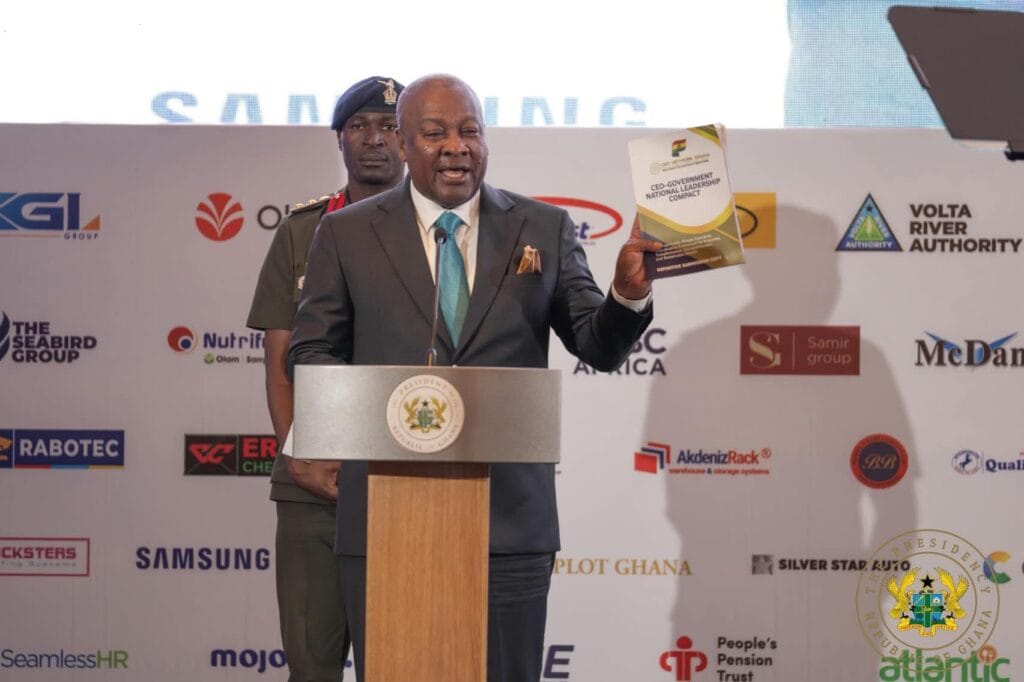
Ghana will process its own crude oil on Ghanaian territory for the first time in years, marking a significant step toward industrial sovereignty, job development, and value retention, according to President John Dramani Mahama.
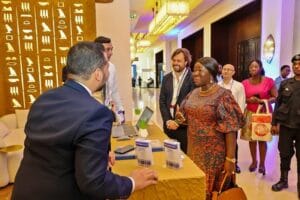
At the Ghana Diaspora Town Hall Meeting in London, the President presented a daring plan to transform Ghana from a simple raw material exporter into a cutting-edge industrial powerhouse based on beneficiation and domestic production in front of a distinguished group of Ghanaians, investors, technocrats, and business executives.
Regarding Ghana’s energy future, President Mahama said that his government is strengthening the nation’s ability to process its natural resources domestically while simultaneously stepping up offshore oil and gas exploration.
The President claims that Ghana has obtained important upstream investments, such as a renewed commitment from ENI of around US$1.5 billion for the Offshore Cape Three Points (OCTP) Field to increase both natural gas and oil production.
However, he stressed that increased output without local processing is not enough.
“We are going to create history once again. We carried it out during my first term, but it stopped after we left office. To thunderous cheers, President Mahama said, “We will deliver a parcel of Ghanaian crude from our own oil fields to a refinery in Ghana for processing in June.”
The announcement is being welcomed as a strategic recalibration to reduce dependency on imported refined gasoline and a pivotal moment for Ghana’s petroleum industry.
Ghana has been exporting crude and reimporting refined goods at high prices for decades. As an unintentional export of jobs, knowledge, and economic impetus, the President denounced this paradigm.
“We typically manufacture and export the oil. After that, we either import refined crude or finished petroleum products. “That cycle needs to be broken,” he said.
He said that local refining would enable Ghana to maximize the value of its resources, strengthen domestic supply chains, spur industrial growth, and create thousands of direct and indirect employment for Ghanaians.
In order to create a fully integrated petroleum value chain that includes extraction, refining, storage, petrochemicals, distribution, manufacture, and exporting, the President emphasized that this refining program is a key component of a larger national economic strategy.
President Mahama made a strong appeal for a national commitment to value addition in all producing sectors, going beyond hydrocarbons.
Using Ghana’s mineral richness as an example, he noted that raw gold, manganese, bauxite, and other minerals are still exported for processing elsewhere, only for high-value derivatives to be reimported at a premium.
“We generate employment in another economy rather than our own when we export raw materials and someone else processes them. After that, the completed goods are sent back to us. He said, “That model cannot produce sustainable prosperity.”
The President said that strategic investments in manufacturing, agro-processing, mineral beneficiation, fertilizer production, petrochemicals, food processing, and industrial parks are essential to Ghana’s long-term growth.
According to economic commentators, this approach might reestablish Ghana as the leading industrial center of West Africa, boosting employment, export growth, and technology transfer.
One of the most significant turning points in Ghana’s modern economic history is the planned June delivery of local oil to a refinery, which is a clear demonstration of the country’s independence and industrial determination.
President Mahama issued a clear command in his closing remarks:
“We must seek value addition in all areas of our economy, including mining, agriculture, manufacturing, and oil and gas.”
The speech served as a focal point of the London Diaspora Town Hall, when President Mahama addressed the Ghanaian diaspora worldwide about investment opportunities, industrial reforms, and tactics to establish Ghana as a competitive hub for manufacturing and processing on the African continent.
The endeavor goes beyond energy policy, since Ghana is about to resume refining its own oil. It is a bold national strategy to create employment, boost indigenous industries, increase economic resilience, and leave a wealthy industrial legacy for future generations.